


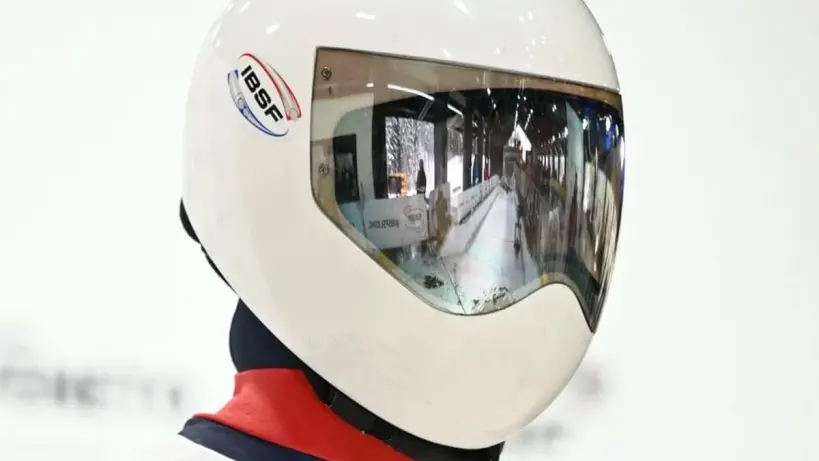
The anticipation was palpable as Team GB, one of the key medal contenders at the upcoming Winter Olympics, faced a setback with their innovative skeleton helmets. The Court of Arbitration for Sport (Cas) has dismissed their appeal to use newly designed helmets, which the International Bobsleigh and Skeleton Federation (IBSF) deemed non-compliant due to their unconventional shape.
On Thursday, the British team sought to overturn the IBSF's decision, asserting that the helmets were crafted with both safety and impending regulations in mind. However, Cas concluded that the helmets deviated from the standard shape, featuring a protrusion at the back that appeared to enhance aerodynamic performance, which is prohibited under current rules.
The British Bobsleigh and Skeleton Association (BBSA) maintained that the helmets were designed to meet future safety standards, anticipated for implementation in the 2026-27 season. Despite the setback, the team remains optimistic, choosing to wear the helmets from the previous World Cup season for the time being.
Visuals shared by BBC Sport highlighted the helmet's pointed rear, resembling those used in track cycling. Executive performance director Natalie Dunman expressed disappointment but emphasized that this decision wouldn't disrupt the team's final preparations or affect their focus. "Our athletes have been successful with their current helmets, and we're confident in maintaining our strong position," she stated.
Leading the charge for Team GB is world champion and World Cup winner Matt Weston, who, alongside Marcus Wyatt, is considered a top contender for medals. The British team previously showcased the new helmets during a training session in Switzerland, shortly before the IBSF's ruling on January 29.
Official training sessions in Cortina are set to begin on Monday, with the men's skeleton event commencing on February 12, followed by the women's on February 13, and the team event on February 15.
'The Importance of Helmet Aerodynamics'
The helmet is crucial not only for safety but also for aerodynamics, determining how swiftly an athlete can navigate the track. Dr. Bryce Dyer, a sport technology professor, explains that the aerodynamic shape is vital for reducing air resistance when sliders race headfirst. The faster the speed, the more critical the helmet's design becomes.
Despite Cas's ruling, which sided with the IBSF's assessment that the helmet included prohibited aerodynamic features, Dyer noted that even minor improvements in velocity could be crucial. "In this sport, where gold can be decided by mere hundredths of a second, every little advantage counts," he remarked.
'Confidence Without the New Helmet'
Despite the denial, Team GB remains undeterred. Weston and Wyatt have dominated this season, winning all seven World Cup races, and the team has qualified three women for the Olympics for the first time in history. The athletes have expressed confidence, stating that their past success came with the older helmets.
"We've achieved all our accomplishments with the previous helmets," Wyatt commented, emphasizing that the decision is a minor setback. "We're still in a strong position to bring home medals," he added. Weston, a three-time World Cup winner, echoed this sentiment, focusing on other aspects of his performance.
Two-time Olympic champion Lizzy Yarnold weighed in, highlighting the importance of innovation in elite sports. "While it's unfortunate, perhaps this process will lead to clearer rules and allow for future advancements," she suggested.








Comments
Log in to write a comment